
The cable car that runs from Caracas to Avila National Park was reopened to visitors on February 9, 2002. It enables thousands of people access to Avila Park that overlooks the capital city.
In 1956, two years before this section of the “Cordillera de la Costa” was declared Avila National Park, both a cable car and a 70-room, five-star hotel were opened as part of an effort to boost the tourist industry in Caracas during times of a growing economy. Fortunately for the conservation of the park, the tourist project was never completely finished and in 1977 both the cable car and the hotel were closed. The cable car was temporarily reopened in 1983 and 1987 and in 1998 the Venezuelan government sold the ownership rights to the private company “Consorcio Mezerhane.”
The cable car begins in Caracas at 1000 m above sea level and rises 1200 meters to Avila Peak in just 10 minutes. It offers a marvelous opportunity to observe the well-preserved forests that in the past, provided water for Caracas. However, it is also possible to see damage caused by forest fires, logging and the introduction of exotic species. Logging and the introduction of exotic species occurred primarily before the area was declared a national park and fires continue to be a serious threat today.
The cable car and tourist area at the summit offer the public an incredible opportunity to be in touch with nature. However, problems related to the increasing amount of visitors are potential threats. According to employees of Inversiones Turísticas Caracas- the subsidiary of Mezerhane that operates the cable car- about 600 people visit daily from Monday to Thursday, 800 people on Fridays and during the weekend it can reach up to 4,000 people per day. During peak time, some 3,000 people occupy the tourist area on the summit. During ParksWatch’s visit there was no INPARQUES (Venezuelan Park Service) presence at the summit. There are neither ranger stations nor information or education centers. In addition, there are plans this year to create a casino on the peak, which is illegal under the terms of the management plan. Increased number of visitors to the park raises concerns, such as the planned reopening of the Humboldt hotel and waste management. Even though there are currently enough trash containers and signs for the present amount of visitors, those could become insufficient with the reopening of the hotel and the subsequent increase of visitors.
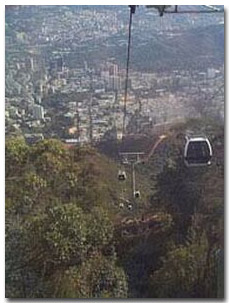
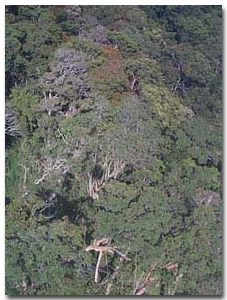
View from an ascending cable car. A view from the cable car of the forest located on
Caracas is seen in the background. the southern slope of Avila
On the other hand, the new cable car could represent a source of income for the local towns such as Galipán, a human settlement inside the park very famous since colonial times for its agricultural products and flowers. Yet, at this time, the food and service areas in the park are mostly occupied by national and international food franchises instead of local businesses.
There is still hope because the tourist area at the summit is not yet finished. There is still a chance to make improvements in the plan, such as stopping the implementation of the casino, guaranteeing INPARQUES’ presence and diminishing other threats to the biological integrity of the park.
The fires on this park during 2001 created public awareness about the importance of preserving this national park, and it seems that public opinion will not support a grand-scale tourist project like the one proposed in the 50’s. It remains to be seen if the new cable car means good news or bad news: it depends on INPARQUES and the park visitors, how they decide to use the new service and how they treat Avila National Park.
(Top photo: During peak hours, approximately 3,000 visitors tour Avila National Park)
ParksWatch: March 2002